
Democracy is Waiting
I got a haircut the other day. My hairdresser’s shop is in a small strip shopping center. Her latest news was that the family that ran the little bodega next door had moved out. In all the years that they had been there, my hairdresser had no idea where they came from, nor anything about the family, but she had a lot of questions now.
Are you moving someplace else? I don’t know yet. Will it be somewhere here in town? I don’t think so. Well, is the whole family moving? We haven’t decided yet. Are you leaving the United States? A shrug of the shoulders. The hairdresser decided she shouldn’t ask more questions.
Some of my favorite servers have disappeared from restaurants I frequent. When I have asked where they are (it’s bad when you lose an excellent employee) I’m told that they are no longer comfortable being in such a visible job. These are not undocumented workers. They just don’t feel safe anymore
Earlier in the week, I had lunch with a good friend. She’s active in a group that has protested against a number of issues. We talked about the direction the group is taking.
I had a few questions for her.
Do you think the group would stand up against ICE? Oh yes, I’m sure they would! Do you think they can handle tear gas and pepper spray in the face? Do you think they could handle physical violence? Silence
Do you think they would be willing to go to jail? Absolutely! What if it’s not the local jail. What if they were taken to a detention center? If they had to call a lawyer, do they have a lawyer other than the family attorney who handles real estate, corporations and wills - one versed in criminal laws? Well probably not. Deer in the headlights look. It hurt to see it.
A short story about a personal experience that triggered this post:
April 1961 - Bay of Pigs failed invasion by the United States. That eventually led to the Cuban Missile Crisis in October 1962.
I was a teen, living in a small (one stoplight) community in north Georgia.
We left the big city some three years before for a distinctly rural area.
My Dad had taken a job with a mining and quarrying company and ran the supply house, supplying everything from diamond drill saws and Euclid trucks to boots and salt tablets for the workers.
Spring of that year was when I first heard the term Bay of Pigs. At the time, I found the name hysterically funny.
It wasn’t.
The invasion of Cuban counter revolutionary forces known as the 2506 Brigade and American forces against Castro’s Cuban Revolutionary Armed Forces was a dismal political and military failure.
You can read history elsewhere, so I’ll save time by not retelling.
By October of the following year, the relationship between Russia and the United States deteriorated dramatically.
As a result, the United States declared an embargo on goods to Cuba and placed nuclear missiles capable of reaching Russia to Turkey, a significant trading partner with Russia.
Khrushchev countered by sending nuclear weapons to Castro in Cuba.
What do you think your family would do when faced with the threat of total annihilation?
My Dad served during World War II as a Technical Sargent in Patton’s army. He knew how to make things happen. At first word of Khrushchev’s actions he headed to the office to survey all the inventory, calculating how it might be needed and to devise a tactical strategy with his coworkers.
The only focus was on how our community could survive a nuclear attack. How many families could be crammed into a tunnel in the side of a mountain?
Mom worked frantically at home to clear out a tiny closet under our stairs. She began refilling it with canned goods, first aid supplies and a change of clothes for each of us. Blankets and pillows and bottled water followeď.
Surely we’d be safe if we all huddled in the tiny hall that was the strongest place in the house.
Like my friend, when faced with the question of lawyers, Mom just couldn’t envision how bad things could be.Her plans were perhaps more applicable to a tornado survival plan than to a nuclear disaster.
My dad, on the other hand, was planning an evacuation to the hills of marble some miles that surrounded us.
The caverns inside those hills were enormous. They had been carved out of marble that created a manmade cavern of enormous proportion. Would they be large enough to hold all the people for miles around?
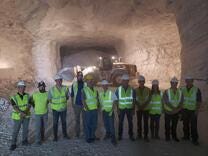
When everyone was in the mine, the men intended to blow the face of the mine. The theory was that we could live in those caverns until all traces of nuclear fallout were gone.
We would never survive with Mom’s survival closet. We’d never survive in Dad’s mountain mine. I was terrified.
We simply weren’t prepared then anymore than most communities are prepared now.
How do we prepare for the challenges of a runaway government and an out of control reactionary force that will, with no provocation, shoot a woman in the face or empty ten bullets into the back of a nurse who was shielding a woman from further harm. What do we say about the six other victims who have died in ICE custody in this year alone
Of course that occurred in Minnesota and other states so the tendency is to shake our collective heads, offer the requisite thoughts and prayers and move on with our everyday lives.
How will a similar set of events be faced if it happens this time in our community?
What I hear:
Georgia is basically a red state, losing the Senate seats was a fluke. You know Trump loves his red states and he wouldn’t hurt them.
He wouldn’t come here because our local businesses and industries contributed heavily to him. He wouldn’t allow raids here. All that ICE stuff is up north.
North Georgia has voted Republican for years. We’ve got nothing to worry about .
Until you do.
There are many reasons to believe that it could, in fact, happen here, not the least of which is the raid conducted on the Fulton County warehouse just south of Atlanta, where the 2000 election records were seized by the federal government.
Six days ago, a local news site posted a rumor of a possibility that a warehouse capable of housing 1,500 beds for detainees would be located in the south part of our county. Local officials denied any knowledge of such a project.
Why would this important issue be reported on a news station as a rumor? Perhaps the acquisition of the facility would be handled as it was quite recently in Surprise, Arizona.
Heather Cox Richardson notes “ICE bought a building the size of seven football fields in the suburbs of Phoenix for $70 million.
From the city of Surprise website:
We understand there are questions about the potential presence of DHS in Surprise, as well as the potential of U.S. Immigration and Customs Enforcement (ICE) operations.
The City was not aware that there were efforts underway to purchase the building, was not notified of the transaction by any of the parties involved and has not been contacted by DHS or any federal agency about the intended use of the building. It’s important to note, Federal projects are not subject to local regulations, such as zoning.”
Take that in for a minute. The federal government can come in and take over a building with no regard for building codes or regulations, but we can sure as heck slow them down.
So what is the citizenry going to do? In cities all over this country, citizens have realized that showing kindness and compassion through action isn’t limited to sign carrying.
In Surprise, Arizona, thousands of people showed up to protest at City Hall. They knew that becoming visible, making state and national media give account of their action provided push back to ICE and the Department of Homeland Security through tangible resistance. The meeting, where everyone who wished to make a statement was allowed to speak, lasted four hours.
That pushback and subsequent letters and calls to three Federal representatives resulted in two letters being written - one to Kristi Noem and to ICE with specific requests regarding the facility’s proposed operational plan and one to the Rockefeller Group, the seller of the facility.
Locally what happens when the government fails us? Communities should be prepared to protect each other from government overreach. When the safety net unravels, as it surely will, will community step up to become the net?
How can communities help protect innocent people?
When DACA and green cards and asylum and application for citizenship become meaningless what will happen to your grad student, your housekeeper, your administrative assistant, your nursing home caregiver, your lawn service?
The alternative for them will be to fall into the hands of individuals who seem not to know the meaning of law and order?
Some cities have formed committees who take the self-directed training and then share the Principles and Steps of Nonviolence from the King Center’s Nonviolence 365 program and share with other community members.
Others have formed a plan for dealing with ICE raids, as citizens did in Minneapolis. Applying the same principles, they have divided into blocks or sectors and committed to ICE Watch in a clearly defined plan.
Using the strategies at 10 Steps Campaign, they have learned how to speak out for democracy.
They understand the value of grassroots movements that can resist the actions of an autocracy. Your group should check out Activist Handbook.
What about local organizations? What about concerned citizens? Will they develop organized district responses and strategies? Will they object to a detention center in their town by doing what is necessary to contact more than local commissioners, council people and take the issue directly to their congressmen and senators? Consider starting at States at the Core and Defend 612.
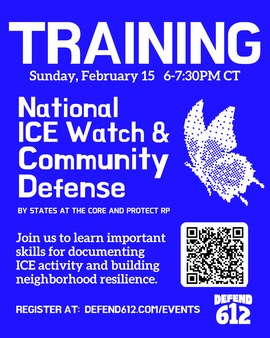
Links to all of these can be found below.
Young people have already stepped up. The walkouts at high schools and colleges are about more than copycatting what students elsewhere were doing. They get that the world is dangerous. Just as I learned as a teen, they know that their communities are not prepared to defend their neighbor. These are the people who grew up with COVID. These are the people who see their world being split apart. These are the people that might never remember what democracy in action looks like.
I learned at an early age the feeling of helplessness and panic when the unimaginable becomes real. I know that the best defense against disaster is to implement critical thinking skills and strategies as a community at the first sign of danger. We are way past that first sign.
If action and advocacy interests you, if you have a brave heart and a willing hand, or if you’d just like to meet for coffee and exchange ideas on how you can take an active part in helping your city stand against governmental overreach drop me a response below and let’s talk. After all, we are all responsible for what happens in our community.
Links: